 |
Circuit de Monaco
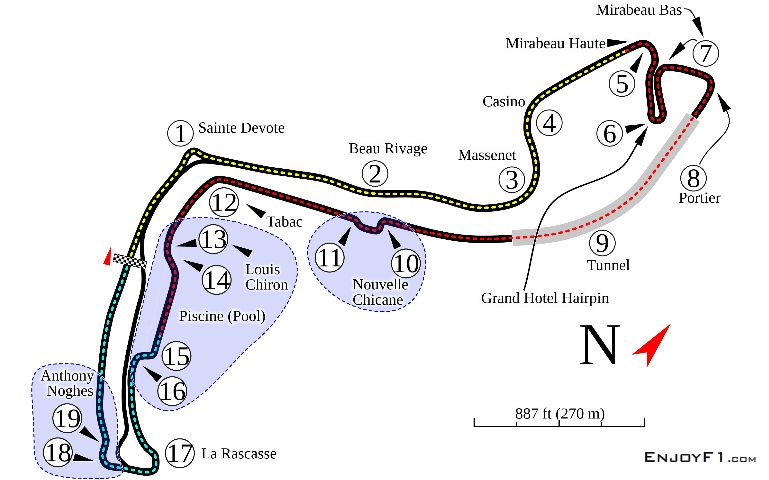
Circuit de Monaco is a 3.337 km street circuit laid out on the city streets of Monte Carlo and La Condamine around the harbour of the Principality of Monaco. It is commonly, and even officially, referred to as "Monte Carlo" because it is largely inside the Monte Carlo neighbourhood of Monaco.
The track has remained substantially unchanged since its creation in 1929: as a city circuit, its conformation is closely linked to that of the principality's road system. The changes were almost entirely connected to redefinitions of the ordinary roads of the town.
In the first editions of the Grand Prix, the start and finish were placed on Boulevard Albert 1er (the innermost straight, which leads to the Sainte Dévote curve). In 1955 the start and finish were moved to the opposite straight, overlooking the promenade (that now houses the pit lane). At the time, neither the Piscine complex nor the "La Rascasse" hairpin existed: after the "Tabac" curve, the route proceeded in the lane that is parallel to today's starting straight: the two sections (separated only by a row of trees) were joined by a single narrow hairpin called the "Gasometer". As can be seen from the period films, in the second half of the 1950s the only existing lane after the Tabac was the one mentioned; in fact, in those years, the lane that we now call "promenade" with the two "Piscine" chicanes was not yet defined, and only in the 1960s images we can notice the progress of the landfilling about that portion of the bay, including the Piscine area which would be completed shortly thereafter.
In 1963 the starting line was moved back to Boulevard Albert 1er (opposite the promenade). The swimming pool and the waterfront lane that 10 years later would become part of the circuit had already been created, but at that point in time no changes were made to the track from the "Tabac" to the "Gasometer".
In 1972 the boxes were moved near the "Chicane" area of the port, so the chicane was relocated closer to the "Tabac" curve. After this, the track continued on the usual straight (parallel to the starting lane) using the "Gasometer" curve for the last time. This solution lasted only a year and, in the following months, the main works were completed in time for the 1973 Grand Prix with the construction of a new section, connecting the "Tabac" curve to "Piscine". This change added 0.133 km to the circuit – bringing its total length to 3.278 km – adding the new portion along the harbour, which followed the layout of the swimming pool and ended in a new chicane around the "La Rascasse" restaurant and a slight climb to the "Anthony Noghes Curve" before rejoining the starting straight. The boxes were reinstalled in the old lane. 1972 was also the last year for the passage through the old tunnel.
In 1973, as anticipated, the track was modified at various points also due to the construction of new civil buildings. In particular, a new hotel was under construction in the "Old Station" hairpin area (Hotel Loews, later renamed Fairmont), resulting in an extension of the tunnel towards the "Portier" curve. Images and videos from 1973 show the unusual passage under the new long tunnel, above which the pillars of the Loews hotel are being built. At the exit of the tunnel there was the traditional port chicane and, after the "Tabac" curve, the new path adjacent to the swimming pools (two "S" left–right and right–left connected by a short straight) and "La Rascasse" hairpin. It was the first year for the new garages in an independent lane, with an entrance just after "La Rascasse", where an asphalt slide was installed to overcome the difference in level from the roadway.
In 1976 the "Sainte Dévote" and "Anthony Noghes" corners were modified: in order to slow down the transit of the cars, curbs and protections were repositioned.
In 1986, thanks to the expansion of the roadway implemented in the chicane area of the port, the chicane itself was modified and made slower: instead of the previously existing fast change of direction, deemed too dangerous, new curbs were installed to design a double turn at 90 degrees. It was then renamed "Nouvelle Chicane".
In 1997 the first "Piscine" corner was modified: the shifting of the track edge protections improved the visibility for the drivers and allowed a higher speed. A year later (at the request of Pasquale Lattuneddu, chief operating officer of Formula One Management), the whole area of the paddock was surrounded with shatterproof fences, in order to reduce and better manage the people authorised to access them.
In 2003 the second "Piscine" curve underwent a treatment similar to that of the first curve, with the shifting of the barriers to improve visibility, while the arrangement of new temporary curbs went to slow down the passage of the cars. However, the most important novelty was the widening of the port lane: in this way the segment between "Piscine" and "La Rascasse" could be rectified, becoming faster and less demanding. The extra space also allowed for the installation of new grandstands and the expansion of the pit lane, which was also equipped with semi-permanent two-storey buildings (instead of the previous tiny prefabricated structures) to better accommodate the teams, the technicians and the material.
Before the 2007 season, the internal curb of the "Grand Hotel" hairpin was significantly lowered and widened, in order to allow the single-seaters to climb on it and eventually face the curve with a narrower trajectory.
Since the 2003 edition, the traffic divider at the "Sainte Dévote" curve has been removed in order to widen the track: the track design is now left to the curb only. This has meant, for safety reasons, an extension of the exit lane from the pits: in practice, once the "proper" pit lane has been left, the drivers must remain in the yellow line that "cuts" the "Sainte Dévote".
The pit lane was further revised in 2004 by reversing the position of the pits with respect to the lane itself, building a much larger and more welcoming structure. Monaco has thus become the only Formula 1 circuit in which the pits are not facing the track, but rather physically separate it from the pit lane.
In 2011, after some accidents that occurred during the race weekend (the Mexican driver Sergio Pérez suffered a rather serious one), the drivers urged a change in the sector between the exit of the tunnel and the "Nouvelle Chicane", complaining (above all) about the disconnection of the road surface and incorrect positioning of the guard rail in the escape route opposite the tunnel. However, these requests were not followed up.
In 2015 the "Tabac" curve was re-profiled, slightly anticipating the entrance and thus shortening the track by three metres (from 3.340 km to 3.337 km today).
| Grand Prix Circuit Layout (2015–present) | |
|---|---|
| Lap Length | 3.337 km (2.074 miles) |
| Corners | 19 |
| Fastest Lap | 1:12.909 Lewis Hamilton / Mercedes W12 2021 Season |
| 6th Variation Circuit Layout (2003–2014) | |
| Lap Length | 3.340 km (2.075 miles) |
| Corners | 19 |
| Fastest Lap | 1:14.439 Michael Schumacher / Ferrari F2004 2004 Season |
| 5th Variation Circuit Layout (1997–2002) | |
| Lap Length | 3.370 km (2.094 miles) |
| Corners | 18 |
| Fastest Lap | 1:18.023 Rubens Barrichello / Ferrari F2002 2002 Season |
| 4th Variation Circuit Layout (1986–1996) | |
| Lap Length | 3.328 km (2.068 miles) |
| Corners | 20 |
| Fastest Lap | 1:21.076 Michael Schumacher / Benetton B194 1994 Season |
| 3rd Variation Circuit Layout (1976–1985) | |
| Lap Length | 3.312 km (2.058 miles) |
| Corners | 20 |
| Fastest Lap | 1:22.637 Michele Alboreto / Ferrari 156/85 1985 Season |
| 2nd Variation Circuit Layout (1973–1975) | |
| Lap Length | 3.278 km (2.037 miles) |
| Corners | 17 |
| Fastest Lap | 1:27.900 Ronnie Peterson / Lotus 72E 1974 Season |
| 1st Variation Circuit Layout (1955–1972) | |
| Lap Length | 3.145 km (1.954 miles) |
| Corners | 13 |
| Fastest Lap | 1:22.200 Jackie Stewart / Tyrrell 004 1971 Season |
| Original Circuit Layout (1929–1954) | |
| Lap Length | 3.180 km (1.976 miles) |
| Corners | 14 |
| Fastest Lap | 1:46.5 Rudolf Caracciola / Mercedes-Benz W125 1937 Season |
| Grands Prix | 71 |